+91 9982316735 travelpeopleindia@gmail.com

+91 9982316735 travelpeopleindia@gmail.com
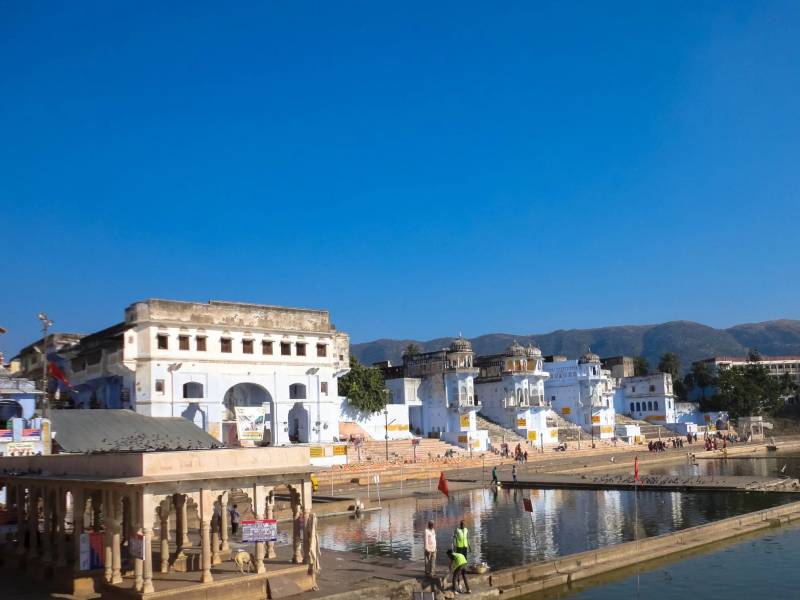
The tour from the sacred town of Pushkar to the fortified riversides of Gagron Fort, which lies in Jhalawar, takes one through the varying landscapes of Rajasthan. The passage from the “Lotus” city of Pushkar to the southeast region of Hadoti witnesses the transition from the desert-encircled hillside ranges to the irrigated plains. Gagron Fort is an important site that goes beyond being a tourist attraction as it is a UNESCO World Heritage Site and an “Oddity” named “Jal Durg” or Water fort.
The desert loops of Jodhpur and Jaisalmer are the most common destinations for adventurers in Rajasthan. The tour to Jhalawar is a much-needed respite from the monotony. The tour connects the religious base with the military history. The formidable fort of Gagron guards a point where two major rivers meet, which is proof of the technical acumen of the Rajputs. It defends itself in a different manner, unrelated to desert dunes or mountains.
Distance between Pushkar to Gagron Fort (Jhalawar): The approximate distance that needs to be covered in travel from Pushkar to Gagron Fort ranges from 300 to 315 kms.
By car – The tour will take around 5.5 to 7 hours, takes us through NH52, passes through Ajmer, Nasirbad and then Kota. The distance from Kota to Jhalawar offers a scenic route when we are approaching the Mukundara hills.
By bus – RSRTC and other transportation services are available from Ajmer to Jhalawar, which is 15 kms away from Pushkar. The tour takes around 8 to 9 hours by bus.
By train – There are no direct trains to Pushkar. One needs to reach Ajmer junction and take a train to the Kota Junction Railway station or the newly established Jhalawar City. The fort is just 12 kms away from Jhalawar City.
About Gagron Fort (Jhalawar):
The Gagron Fort has been an awe-inspiring structure located in the Jhalawar region, 12 kms away from the main city. There’re six hill forts in Rajasthan that have been labeled as a World Heritage Site by UNESCO. Gagron stands out to be a Jal Durg, surrounded by the sparkling river waters of Ahu and Kali Sindh on two sides and a deep ditch on the other side. The fort lies atop a low range of the Vindhya Ranges and strangely enough, the fort has no foundations. The earthly landscape gives a refreshing contrast to the usual gold-brown sandstone hues of Rajasthan. The effect of this gives the impression of the fort being afloat.
Gagron Fort (Jhalawar) –
History repeats at Gagron Fort, chronicled with 14 wars and two Jauhars-mass self-immolation by women. The fort was founded in the 12th century by King Bijaldev of the Parmar dynasty, popularly known as Dod Rajputs. Khinchi Chauhans kept its possession for almost 300 years. Its vantage location made it an envied prize for both the Rajput Kings and the Muslim Sultans from Malwa and Delhi.
Gagron is unique from other Indian forts, as it has three huge concentric walls instead of two layers and therefore was practically invincible in its time.
The fort has two entrances, Ganesh Pol and Suraj Pol, through these imposing gateways, one reaches into a complex containing palaces, temples, and barracks.
Dargah of Sufi Saint Mitthe Shah is an adobe of great religious peace that still bears a vibrant market during every Muharram. A unique feature and quite well-known are the Hiraman Parrots of Gagron.
Car Rental for Pushkar to Gagron Fort (Jhalawar):
Booking a car rental in Pushkar for the 300 km drive to Jhalawar is highly recommended so that you can visit the fort and the surrounding Jhalawar city. Our car rental services for outstation trips from Pushkar to Jhalawar are best suited for tours of 250-300 kms. You may wish to plan two days for the visit, as the 6 hour drive for the one-way trip may be too tiring for one day only. One can have lunch along the Kota River or visit Jhalara Patan or the city of the temple bells, which lies 7 kms away from Jhalawar and boasts the magnificent 10th-century Sun temple.
FAQs on Pushkar to Gagron Fort (Jhalawar) Distance:
In which season should Gagron Fort be explored?
The best season is between September and March. The monsoon is particularly beautiful as the river is full of water, though the winter season is best suited for walks around the rock-cut style fort.
Is there an admittance charge at the fort?
There are nominal charges to enter the fortress, like ₹50 for Indians and ₹200-₹300 for foreigners. Photography could also incur some nominal charges.

Share your query now and we will write you back in the shortest possible time including very possible detail.
Related Tours
Share your query and our team will respond quickly with the best travel assistance.
Near Gurudwara Bus Station, Choti Basti, Near Vamdev Road, Pushkar, Ajmer - 305022 info@ajmertaxiservices.com
Copyright 2026 Ajmer Taxi Services. All Rights Reserved